

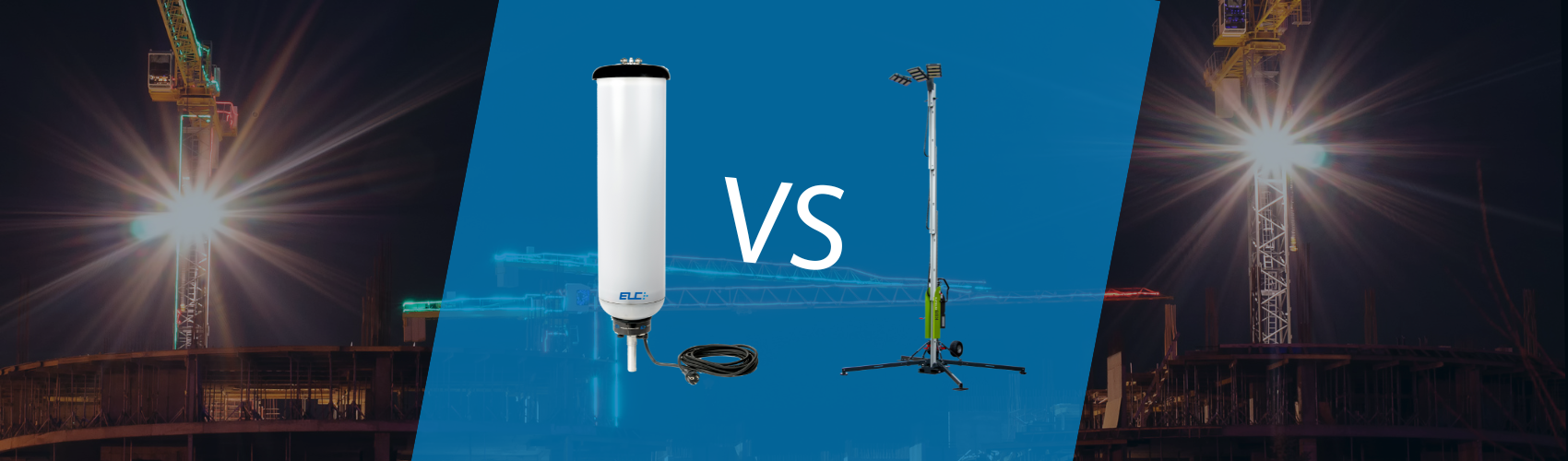
What type of professional lighting should I choose between a lighting tower and a site lighting balloon?
Choosing the right professional lighting can seem complex, given the variety of options available on the market. However, by taking certain key factors into account, you can determine which solution is best suited to your specific needs.
Understanding your professional lighting needs / How to choose the right professional lighting for your needs
The first step in choosing the right professional lighting is to understand your exact needs. Here are some questions to ask yourself:
- What is the area to be lit?
The size of the space to be lit will influence the type and power of lighting required.
- What level of brightness is required?
Light output is measured in Lumens. Make sure the equipment you choose provides enough Lumens your specific needs. For example, a construction site will require much higher light intensity than an outdoor event.
- Which energy source should I use for my professional lighting?
Determine whether you have access to a reliable power supply, or whether you'll need stand-alone solutions such as battery-powered equipment. You can also opt for hybrid lamps like the V20 road towable lighting trailer offered by our distributor Labérine.
- What type of use (indoor or outdoor)?
If you plan to use the lighting outdoors, make sure the equipment is weatherproof. Lighting towers are often more robust and better suited to harsh outdoor conditions.
- Ease of installation and portability of professional lighting?
For temporary applications or changing sites, portability and ease of installation are critical factors. Lighting balloons are generally easier to move and install than lighting towers.
- What is the useful life?
The length of time you'll need the lighting can influence your choice, especially if you're looking for economical, long-lasting solutions. LEDs, for example, may have a higher initial cost, but offer long-term savings thanks to their energy efficiency and durability.
Once your requirements have been defined, let's compare the characteristics of lighting towers and illuminating balloons.
Lighting tower or site lighting balloon for professional lighting?
Lighting towers are generally very powerful and can cover large areas, making them ideal for large construction sites or large-scale events. These towers can be adjusted in height, offering the flexibility to direct light exactly where it's needed.
Take a look at our K65 mobile lighting mast, with its high power output and ability to illuminate large areas. With LED floodlights ranging from 200 to 240 watts each, the K65 can achieve a total luminosity of 97,000 to 195,000 Lumens. Its innovative, compact design enables rapid deployment by a single person, in less than 3 minutes. With all-terrain wheels and adjustable feet, installation is easy even in tight spaces. In terms of strength, it can withstand winds of up to 50 km/h. The K65 is powered either by the mains or by a diesel or petrol generator, requiring between 730W and 1460W depending on the number of floodlights installed. Weighing in at 250 kg, it is heavier and less portable than a site lighting balloon. However, it offers luminous power and coverage suitable for large construction sites, sporting events and other applications requiring intense, directional light.
Construction lighting balloons produce a diffused light that reduces shadows and glare, creating a more comfortable working environment. Often lighter and easier to transport than lighting towers, they are ideal for sites where mobility is important. They can be set up and dismantled quickly, making them ideal for temporary events or emergency situations.
For example, our best-seller LUMAPHORE® 600XL is a compact, powerful lighting balloon, appreciated for its small size and light weight, making it a major asset in a wide range of applications. With a light output of 76,200 Lumens for just 600 watts, it offers an impressive lighting coverage of 3,200 m². In terms of robustness, the LUMAPHORE 600XL is waterproof, dustproof, shockproof and windproof (up to 162 km/h), with IP65 and IK10 ratings, guaranteeing long-lasting, reliable use on worksites. Its 50,000-hour service life and rapid set-up time (approx. 2 minutes) make it particularly suitable for a wide range of sectors, including construction, emergency services, events and cinema.
When choosing between a lighting tower and a lighting balloon for professional lighting, it's essential to understand the specifics of each option to determine which is best suited to your needs. Lighting towers are renowned for their power and ability to cover large areas, making them ideal for large construction sites or large-scale events. Their adjustable height allows light to be directed precisely where it's needed, while their stability and weather resistance make them robust tools for long-lasting outdoor use.
In contrast, illuminated balloons produce a diffused light that reduces shadows and glare, creating a more comfortable and safe working environment. Their portability and ease of installation make them practical choices for sites where mobility is essential, such as temporary events or emergency response. In short, the choice between a lighting tower and a lighting balloon depends on the need for intense light output and wide coverage versus diffused light and flexible installation.
If you're looking for rechargeable equipment, consider our high-power stand-alone projectors, such as the K10, which delivers 12,000 Lumens.
How to extend the life of your professional lighting
Extending the life of your professional lighting systems, whether towers or balloons, requires regular maintenance and proper operating practices. First of all, it's crucial to follow the manufacturer's cleaning and maintenance recommendations. This includes regular inspection of electrical and mechanical components to detect and repair signs of wear or damage before they cause major breakdowns. Next, be sure to protect your equipment from extreme weather conditions by using protective covers or storing it in sheltered locations when not in use. Finally, make sure that cables and connectors are in good condition and well connected to avoid short circuits and electrical overloads. By adopting these good practices, you can maximize the longevity and performance of your lighting towers and illuminating balloons, ensuring reliable, long-lasting lighting for your projects.